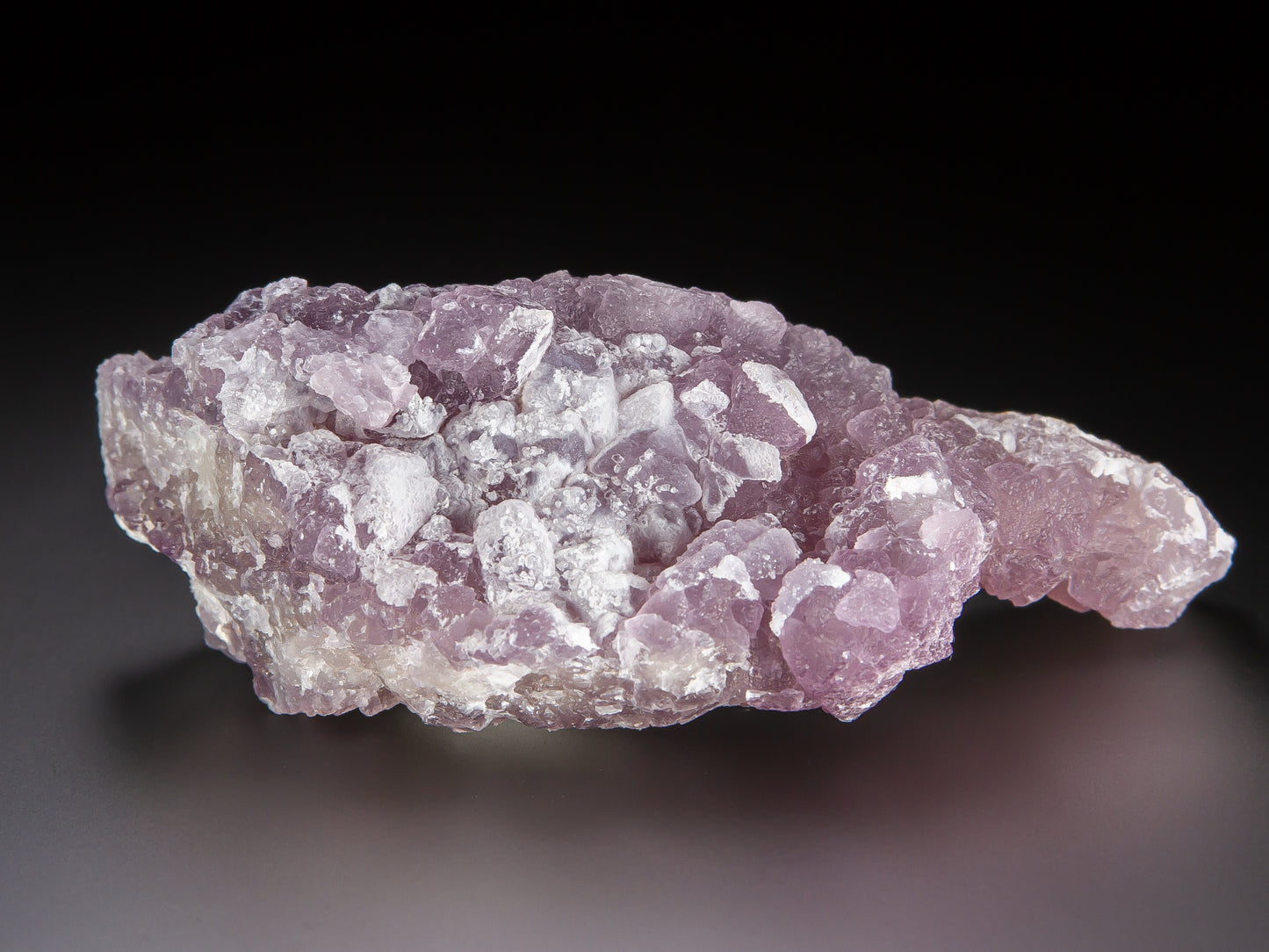
The region now known as the Tombstone mining district was once covered by the shallow waters of a small sea. Over time, many layers of sediment accumulated to eventually form a thick package of sedimentary rocks. Tectonic activity later gave rise to the Tombstone Hills, and various intrusive events invaded and altered the metasedimentary rocks of the region. This multi-stage geologic history provided the specific conditions needed to form these unique and intriguing specimens.
Tombstone fluorite specimens stand apart from other fluorites for several reasons. Fluorite is a member of the isometric crystal class and occurs in both cubic and octahedral forms, though cubic is far more common. Tombstone crystals, however, range from octahedra to cuboctahedra, with some displaying rounded sides or appearing nearly spherical. While this morphology alone sets them apart, their pairings with quartz and orthoclase add further mineralogical intrigue.
Some specimens feature a type of pseudomorph known as an epimorph, seen in this locality as quartz after scalenohedral calcite. In an epimorph, one mineral forms as a coating along the surfaces of another, and the original mineral later dissolves, leaving a cast of its shape. This replacement and dissolution occurred in heavily fractured limestones, where hydrothermal fluids moved through the rock, depositing quartz on scalenohedral calcite while dissolving the calcite itself. The process points to an acidic environment, since quartz forms under the same conditions that dissolve calcite.
Once the quartz pseudomorphs had formed, fluorite filled the voids around them. In some specimens, this appears as glittery white planes extending between groupings of purple fluorite, a pattern collectors often call 'boxwork' or 'boxwork structures.' Orthoclase is also present in some specimens, generally appearing as groupings of small, cream-colored rhombohedrons that peek out from beneath the fluorite crystals.
Couldn't load pickup availability
Free Shipping Within the United States.
Returns Accepted Within 30 Days.
Photos are taken under bright studio lighting. More photos and video available upon request. Contact us.